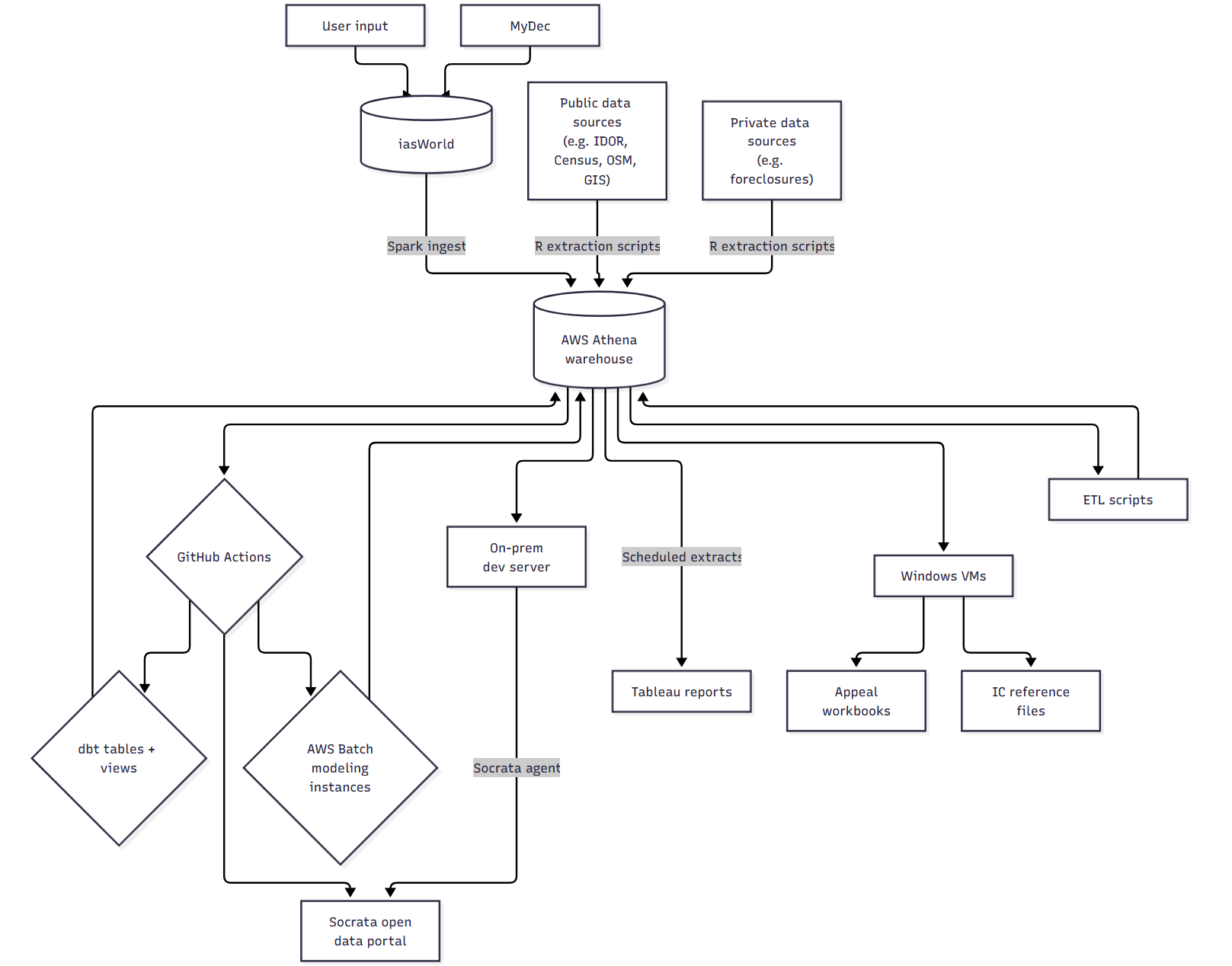
While my official job titles during my time on the Data team at the Cook County Assessor's Office (CCAO) have technically been "Senior Data Scientist" and "Interim Director of Data Science", my primary role on the team has actually been to manage the design and implementation of the infrastructure that supports our data science and analytics work. (A common government story: "data engineer" is not a job category at the CCAO, and creating the category would take a huge amount of time and effort, so I got hired as a "data scientist" with the understanding that I would spend most of my time doing data engineering.)
Over time, our data systems have matured to the point that we can move quickly in response to shifting organizational priorities without worrying much about budget or infrastructure. We run all of our models in parallel on ephemeral batch compute environments in the cloud; we manage our Athena data lake through dbt and GitHub Actions, with CI/CD performing the bulk of the QC and deployment necessary to push changes to the lake; and we record all of our cloud resources in a Terraform project, ensuring that all changes get the proper review and approval. In general, we only pay for the resources we use, and the services we use are either cheap or free-and-open-source.
This data architecture makes it easy for us to, say, QC a fresh batch of sales and rerun our annual valuation model using the new training data, or migrate a manual QC process into Tableau so that subject-matter experts don't need to run 16 hefty queries by hand whenever they want to gut check assessed values before certifying them. It also allows us to run automated tests to ensure the integrity of our source data, which is critical given the lack of constraints in the CCAO's source-of-truth database.
Recently, I had the opportunity to spend some time documenting our team's data architecture for the benefit of other lean public-sector data teams. Head over to the CCAO Data team blog to read the full post.